
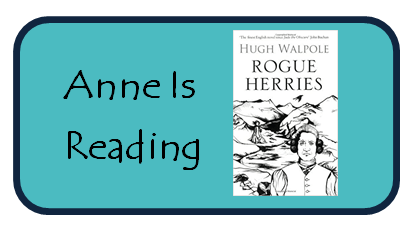
Many years ago when I was a teenager and exploring the delights of the library and the variety of reading it had to offer me I found a series of books by Hugh Walpole. They were thick novels but that didn’t worry me in those days and I had heard nothing about them – in fact, I don’t think that I have ever seen them mentioned in the blogs and websites I read about books. Recently I found all four books for sale at a ludicrous price in a charity shop in Dewsbury and thought that I might like to reread them to see what I thought over forty years after my first reading. Rogue Herries is the first novel in the set and it is a family saga starting in the eighteenth century and going on until the twentieth – the child born on the last page of this first novel dies on the very first page of the final novel, having lived to a very old age.
The story focusses on Francis Herries. He is a man of uneven temper and random cruelty who comes with his wife, his two daughters, his son and his mistress to live in the Lake District (near to Keswick) just before the time of the Jacobite Uprising. The story is told in a series of episodes as the family connect with other relatives there, are involved with a woman condemned as a witch, are trapped in Carlisle as war breaks out and Francis sells his mistress at a local fair. We mainly follow Francis and his son and their relationship during the book.
The author paints a picture of the region as cut off from the rest of England and very superstitious, although there are some unexplained events in the book which may or may not be true. He assumes that travellers (gypsies) have supernatural knowledge and that colours the relationship of the family and of the local people with them. Francis is never satisfied with what he has and always wants something else. The family live in a large house which is mostly derelict and fail to make a living at farming.
This is an entertaining book and Francis is an interesting main character, although by no means a sympathetic one. I’m not completely convinced that all the social and cultural history is accurate but the author certainly knew his landscape and as the area is reasonably familiar to me that enhanced my enjoyment of the story. I shall definitely go on to read the other three books and see what the author does with this dysfunctional, shabby but proud family next.
 Anne Is Reading