
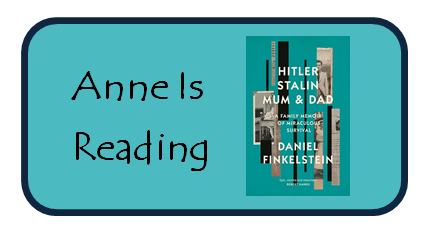
In his family memoir Hitler, Stalin, Mum and Dad the journalist Daniel Finkelstein talks about how his family experienced some of the worst episodes of twentieth century European history. He is clear about how the survival of his parents was often just about luck and about how many others suffered terrible fates. It’s not an easy read but it is a moving one.
The author’s German mother was the child of a political thinker who gathered information in the 1930s about the atrocities of the Nazis and publicised it to try to bring the situation in Germany to the attention of the world. He eventually had to move his family and his archive of documents to Amsterdam and when the war broke out he took them to London. His family was supposed to follow shortly afterwards but invasion changed that eventually his wife and three daughters, because of their Jewish faith, ended up in the Belsen concentration camp at the same time at Anne Frank was there.
The author’s father came from Lwow which at that time was in Poland (it is now in Ukraine). He and his mother were exiled to Siberia and forced to labour under inhuman conditions whilst his own father was sent to a camp in the Gulag. Another book talking about events in that city at exactly this time is East West Street by Philippe Sands (review here).
The stories of how the two small family groups made their way to the UK are remarkable. At every point on the journey they could have been killed or returned to imprisonment. So many people did not escape and they are remembered in this book too. The story also talks about their challenge to establish themselves and build a life in this country and of the importance even today of the archive of material which was rescued from Germany.
This is a story of the persecution and suffering of ordinary people living under two horrendous totalitarian regimes. It’s about bravery and stubbornness and taking advantage of opportunities. It’s also about the politics of the time, loyalty to one’s identity and being at the whim of powerful people. There are, sadly, echoes of things we can see in the current political landscape in these events and especially in the attitude towards refugees.
This story is told well and clearly. It sets the family events in historical context and has the advantage of letters and family memories to humanise and enrich the narrative. I found it moving and absolutely compelling reading.
 Anne Is Reading
One thought on “Two families, two dictators”