
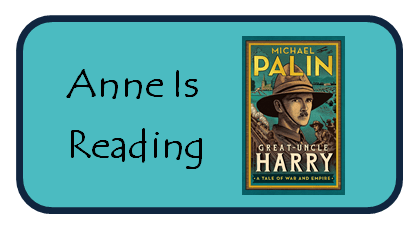
Michael Palin’s book Great-Uncle Harry is a biography of an ordinary man who lived in extraordinary times. It’s a compelling story.
Harry was born in the late nineteenth century into a comfortable middle-class family. He was one of several children and his path was set out for him – public school, university, a professional career, and a wife and family – except Harry didn’t really fit in. He wasn’t disabled or seriously mentally unwell but he was restless and unhappy. His family rallied around and with their connections found roles for him in Sri Lanka and India. Eventually he ended up in Australia, where following the outbreak of WW1 he fought in Gallipoli and was eventually killed in Northern France.
Harry wasn’t unusual in any way. He was fortunate to have the family connections to obtain work abroad and he lived in a time when these opportunities were available. He was unfortunate to be involved in war and to have his life taken when he was a young man.
The author has collected family papers and Harry’s diaries which show us how he lived and what happened to him as well as seeking out official documents which give us the facts of his life. The book also gives us the social history background of a world in which young men became managers and workers in the larger empire. There is some interesting analysis of the disaster which was Gallipoli. The narrative is beautifully created so that we begin to understand Harry’s life and the choices available to him – we also learn the experiences of his siblings. Harry’s journeys are revisited by the author who describes what Harry would have seen.
Harry’s is a name on a war memorial now. There is no one alive who remembers him. Without this biography he would never have come to anyone’s notice. This book is a tribute to those ordinary men who lived and worked and died in circumstances that we should never forget.
 Anne Is Reading
2 thoughts on “The life of an ordinary man”