
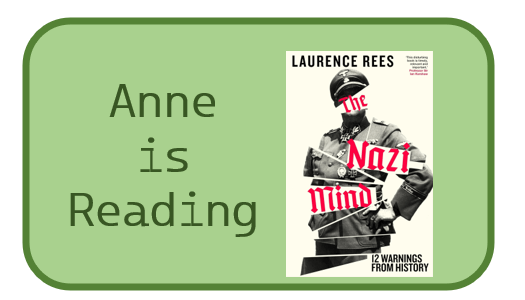
For those of us who have read anything about WW2 one of the questions we frequently ask is how the Nazi Party could have come to power and committed the atrocities that they did without the majority of Germans rising up and putting a stop to what was happening. In his book The Nazi Mind Laurence Rees tries to answer that question by looking at twelve things that enabled ordinary people to take part in atrocity or to accept it. I read this book as an audiobook which was narrated by John Sackville and which I chose as one of my audiobooks of the year (see here for the others).
The author shows the various techniques which the Nazis used to win hearts and minds to their cause. The first of these was to divide people into “us and them” and then to vilify “them”, including blaming “them” for problems and issues affecting “us”. He talks about psychological theories that show how groupthink works, how easily people are drawn into conspiracy theories and how our attitudes to authority affect obedience. He shows how the suspension of human rights became accepted, along with open attacks on consenting voices. Marketing tools are also examined showing how important propaganda was to further the cause, especially when combined with widespread censorship of opposing views. It’s fascinating stuff which has been touched on in other books I have read but which is particularly powerful when all brought together in one place.
It cannot escape the current reader how many parallels there are between what happened in Germany in the 1930s and 40s and what we see today in Europe and America, especially with the rise of right wing, populist political parties and movements. It’s quite chilling to see these techniques being used in our current world and to be able to see examples in the world around us – the author describes this book as “twelve warnings from history”.
This book is written in an easy to understand way for those of us who are not historians and I found the contents fascinating, and also quite worrying.
 Anne Is Reading