
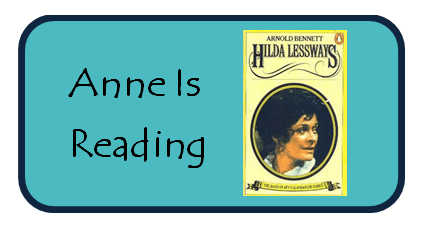
Hilda Lessways is the sequel to Clayhanger (which I review here). Actually, it’s not really a sequel but a book which runs parallel with the first volume. In Clayhanger the hero Edwin Clayhanger falls in love with Hilda but she disappears and he doesn’t know what has happened to her – this second book is Hilda’s story told from her point of view. Like the first one it is set in a town in the Potteries in the late nineteenth century (although Arnold Bennett wrote it in the 1920s) although during the course of the book Hilda moves to London and then Brighton.
Hilda is the only child of a fractious and demanding mother who lives on the rents that she gets from various rental houses in poorer parts of the town. Hilda has lived a sheltered life but begins to break free. Unfortunately, she does this by becoming enthralled by George Cannon who is working as a local solicitor and who takes responsibility for her and her money when her mother dies.
Cannon is a chancer and it is obvious to the reader that he is taking advantage of her. She travels to London and lodges with Cannon’s aunt who is running a lodging house and eventually all three of them move to Brighton where Hilda and Cannon eventually marry. Hilda enjoys the love that she has for Cannon and romanticises it while totally failing to see that he is just using her and her money in an attempt to make something of himself. Hilda finds herself adrift and Cannon is the only person she knows well enough to think she can rely on in a strange place. If the story was written today we would say that Hilda is the victim of coercive control.
The book is remorseless in showing us how, in the society of the time, women are totally dependent on men for their business matters and also for their social standing and also how vulnerable they are. If Hilda had joined with Edwin Clayhanger as he desired it would have been more of a meeting of equals, although her legal submission would have been the same, but she is drawn to Cannon by a strange fascination that she can’t understand or fight.
This isn’t the classic that Clayhanger is but it’s still a fascinating story and I enjoyed it a lot. There is a third book in the set and I look forward to seeing what the author does with the characters next.


I saw the TV adaptation in the 70s and then read the books. I preferred the TV version.
LikeLike
I have not seen the TV version but the books are good reading and stand up quite well today I think
LikeLiked by 1 person