
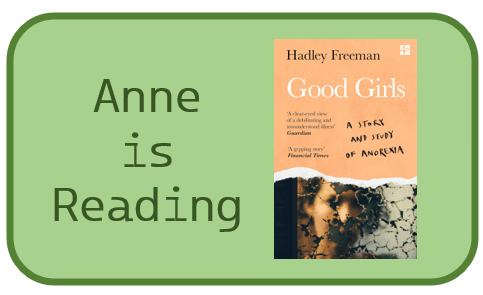
In Good Girls the author Hadley Freeman details her adolescence struggle with anorexia which involved three years mostly living in psychiatric wards of various hospitals. It’s not an easy read because she talks about what she was feeling and the strategies that she used to avoid eating and much of this made me very sad and frustrated that these young people, usually female, are so resistant to help. The author also writes about the prevalence of anorexia and how it is one of the least understood mental illnesses.
The author makes it clear that her illness was not just a matter of wanting to be thinner but was actually a rejection of herself and of femininity, as she thought that the world saw it. She felt that every mouthful she ate was somehow giving into the pressure to conform and that the only way that she could control her life was to refuse to eat. She was afraid of becoming fat, the same as she was afraid of growing up and maturing into an adult, sexual woman. Obviously it’s more complicated than I have described here, but the author has thought through her motivations and researched the subject so she can give a more detailed description of the disease than we usually see in the media.
There is also much description of what various authorities and mental health professionals did to try and ensure that the author recovered. She is honest about the deceits that the patients practised on the staff and how they egged each other on to eat less and less. The treatments were mixed and often seem quite cruel but they did work and the author has moved on from her eating disorder in adult life.
This is a fascinating book because it is so honest and because it tries to explain, to the ordinary reader, something which is very complicated and misunderstood. The author also transfers her thinking to people who wish to change gender, arguing that often their motivations are the same – it’s interesting to consider her theory.
I am glad that I read this book and feel that I might have a bit more understanding of this terrible condition. I have also read this author’s family memoir, concentrating on their time in France between the World Wars, as Jewish people during the Nazi rise to power and eventual occupation – see my review of that book here.

